



Armenia, the first country in the world to officially adopt Christianity in 301 AD, combines within a small area ancient monasteries, mountains, valleys, and food with a distinctive identity. From Dubai, the journey takes about three and a half hours, while Mount Ararat appears on the horizon from many locations inside the country despite being located on Turkish territory.
UAE residence holders from eligible categories benefit from facilitated entry arrangements, while UAE nationals enter without a visa according to the applicable rules. If you are looking for what to do in Armenia, this guide brings together the most important landmarks and experiences that can be added to your program.
Best Things to Do in Armenia at a Glance
Armenia’s small size makes it possible to combine historic cities, monasteries, and nature within a single trip, especially when using Yerevan as a base for setting out to the surrounding areas. These are the most notable experiences worth including in your program:
- Yerevan Cascade: a large terraced complex providing a panoramic view of the city and Mount Ararat.
- Blue Mosque: the only surviving historic mosque in Yerevan, dating to the eighteenth century.
- Tsitsernakaberd Genocide Memorial: one of the most important commemorative and historical sites in the capital.
- Geghard Monastery: a thirteenth-century monastery partially carved into the rock and listed among UNESCO sites.
- Garni Temple: a classical temple dating to the Roman period and considered one of Armenia’s most prominent monuments.
- Symphony of Stones: natural hexagonal basalt columns extending through the Azat River valley.
- Khor Virap: a historic monastery providing one of the most famous views of Mount Ararat.
- Tatev cable car: an aerial journey of 5.7 kilometers above the Vorotan Valley to Tatev Monastery.
- Lake Sevan: one of the largest high-altitude freshwater lakes in the world.
- Dilijan National Park: a forest and mountain trails area known by the nickname Switzerland of Armenia.
- Gyumri: a historic city with an architectural and cultural character different from Yerevan.
- Haghpat and Sanahin: two historic monastery complexes listed on the UNESCO list.
What to Do in Armenia
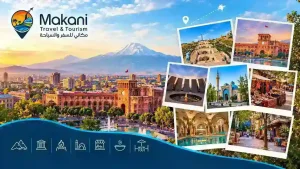
When deciding what to do in Armenia, you will find that experiences vary between ancient Christian landmarks, historic cities, lakes, forests, restaurants, markets, and traditional crafts. Yerevan works well as a comfortable starting point, and from it a large number of sites can be reached on day trips, while areas such as Syunik and Lori require more time. Dividing the trip this way helps you see different sides of the country without turning the program into a continuous series of transfers:
Best Things to Do in Yerevan
Yerevan combines stone architecture in pink and red tones, wide squares, museums, markets, and cafes. Most of the main landmarks are located in areas easily connected by walking tours, so a full day can be dedicated to the capital before moving to the surrounding areas.
The Cascade
From Tamanyan Street, the Cascade’s steps climb gradually toward Victory Park, and along them sculptures and artworks by Armenian and international artists appear. Reaching the upper levels gives you a wide view of Yerevan, and Mount Ararat may appear on the horizon when the air is clear. After evening falls, the area surrounding the complex becomes an active gathering point with the illuminated steps and the movement of residents and visitors.
Republic Square
In the heart of the capital, Republic Square appears surrounded by pink stone buildings that reflect Yerevan’s architectural character during the Soviet era. The National History Museum overlooks the square directly and holds archaeological collections spanning different phases of Armenian history. Sitting at one of the surrounding cafes gives you a quiet angle for watching the city in the evening.
Tsitsernakaberd Genocide Memorial
Above a hill overlooking Yerevan sits this commemorative site linked to one of the most sensitive periods in Armenian history. The complex includes the Eternal Flame and the museum that displays documents, photographs, and archival materials, giving the visit a clearly historical and human character. Entry to the site is free.
Blue Mosque
Yerevan once had a number of mosques during different historical periods, and only the Blue Mosque remains standing today. The building dates to the eighteenth century and underwent restoration with Iranian support, and it opens for visits at specific times. Behind the entrance extends a quiet interior courtyard surrounded by plants, in a clear contrast with the movement of the city center.
Vernissage Market
On weekends, the open space near Republic Square fills with handicrafts, carpets, artworks, and old photographs. Bargaining over prices is a usual part of the purchasing process, while the products give an opportunity to learn about aspects of Armenian craft and culture. The market’s location close to the city center makes it an easy stop within a city tour.
Arasyan Baths
The Arasyan Baths retain a clear Soviet character since their operation in the 1970s, and they include sections inspired by Russian, European, Eastern, and Finnish traditions, alongside private room options. The experience differs from a modern hotel spa, and it can be included in the program as a rest period after hours of sightseeing.
Saryan Street
Yerevan’s cultural scene appears on Saryan Street through art galleries, specialty shops, and cafes. The tour needs no fixed schedule: walking through the street during the evening reveals a side of the capital’s daily life, away from the sites that visitors seek out only to see landmarks.
Best Day Trips from Yerevan
Yerevan’s geographic location makes it a practical base for day trips, as a large group of Armenia’s most famous sites are at distances that can be covered and returned from on the same day. Some routes are short and straightforward, while trips heading north or south need a full day because of the length of the road:
Garni, Geghard, and Symphony of Stones
Three nearby sites that can be combined in a single trip, usually starting at Garni Temple, which dates to the first century AD and stands above an elevated area overlooking the Azat River valley.
Below, the columns of the Symphony of Stones appear in basalt, with some reaching approximately forty-five meters in height. The route then moves to Geghard Monastery, listed among UNESCO sites, where sections of the complex were carved into the rock mountain and some interior spaces are distinguished by notable acoustics.
Khor Virap and Etchmiadzin
Khor Virap is about forty-five kilometers south of Yerevan and is known for its location that allows a view of Mount Ararat when the air is clear. The area is linked to the story of Saint Gregory the Illuminator, whom Armenian tradition holds was imprisoned in a deep pit for seventeen years. The road can then continue to Etchmiadzin, the seat of the Armenian Apostolic Church and one of the sites listed on the UNESCO list.
Lake Sevan
At an elevation of approximately 1,900 meters, Lake Sevan extends as one of the country’s most prominent natural destinations. The road from Yerevan takes about an hour, and the area allows for exploration, walking, and boat riding during the suitable season.
Ascending the Sevanavank Peninsula adds a historical dimension to the trip, where two ninth-century churches stand, while the lake’s shores become more active during summer.
Noravank and Tatev
The trip to Noravank and Tatev needs a long day, but it combines two of southern Armenia’s most prominent sites in a single route. Noravank appears inside a valley surrounded by red and orange rocks, while Tatev sits above the Vorotan Valley.
Reaching the monastery via Wings of Tatev adds an independent aerial experience, as the cable car extends 5.7 kilometers and set a world record in 2010.
Haghpat, Sanahin, and Debed Canyon
In the Lori region, Haghpat and Sanahin are spread above mountain terrain overlooking Debed Canyon. Haghpat’s construction is linked to the reign of King Ashot III in 976 AD, while Sanahin holds an important collection of khachkars, the Armenian cross-stones.
Including both sites in a single trip allows for seeing a prominent part of Armenian architecture and culture from the medieval period.
Ready for Armenia? Contact our team today and let us create a seamless travel experience tailored to your dates and preferences.
Best Things to Do in Northern Armenia
The further north you go, the scene shifts from the relatively dry areas to forests, valleys, and greener mountain spaces. Lori and Tavush combine UNESCO sites with national parks, monasteries, and historic villages, and so this region needs two days or more if you want to explore it without rushing:
Dilijan
Dilijan is known by the nickname Switzerland of Armenia because of its dense forests and surrounding mountains. In the old Sharambeyan neighborhood, traditional nineteenth-century wooden buildings have been converted into craft workshops, cafes, and cultural spaces, while outside the city trails begin leading to Haghartsin, Goshavank, and Makaravank. Lake Parz adds a quiet stop suitable for families and nature lovers.
Haghpat and Sanahin
Both monasteries offer an integrated experience of Armenian medieval architecture, and both are listed among UNESCO sites in the Lori region. Haghpat draws attention with its multiple churches, stone carvings, and views over the valley, while Sanahin is known for its cemeteries and the khachkars spread around it. The trip from Yerevan takes about three and a half hours, and the road passes through the scenes of Debed Canyon.
Lori Canyon and Debed Canyon
Debed Canyon forms an important part of the road heading from Yerevan toward the Georgian border, with hiking trails and areas suitable for some outdoor activities spread around it. The village of Odzun is worth stopping at to see its elevated church, while Akhtala offers a fortress and a monastery decorated with rare frescoes from the twelfth and thirteenth centuries.
Read more: Armenia Best Time to Visit
Things to Do in Southern Armenia
Syunik in southern Armenia presents a more dramatic scene, where deep canyons intertwine with monasteries built above plateaus and villages surrounded by mountains. Reaching this region takes longer than the trips close to the capital, but its nature and historical sites make it an important part of a longer trip:
Noravank
Inside a narrow valley surrounded by red and orange rock walls, Noravank Monastery appears, dating to the thirteenth century. The decorated facade of the Church of Surb Karapet and the small external staircase leading to the upper floor are among the complex’s most distinctive details. Nearby lies the village of Areni, known for its vineyards and the Areni Cave, where a leather shoe dating back approximately 5,500 years was found.
Tatev
Above the edge of the Vorotan Valley stands Tatev Monastery, dating to the ninth century. The Wings of Tatev journey takes about twelve minutes above the valley and extends 5.7 kilometers, setting a Guinness World Record in 2010. Near the monastery lies Khndzoresk, where cave dwellings carved into the rocks and a suspension bridge can be explored.
Shaki Waterfalls
On the road between Noravank and Tatev, the Shaki Waterfalls provide a suitable natural stop. The water falls from a height of approximately 18 meters amid trees and rocks, while winter gives it a different appearance when parts of the waterfall freeze.
Things to Do in Gyumri and Western Armenia
Gyumri, Armenia’s second largest city, differs from Yerevan in its urban form and cultural rhythm. The city suits those who want to see another side of the country, especially through its old stone neighborhoods and museums that preserve its local memory:
Kumayri Historic District
Black and red basalt stone buildings appear in the Kumayri district, with much of the area’s fabric dating to the nineteenth century. During the Russian era the city carried the name Alexandropol, and this left a clear influence on its layout and facades. Two hours of walking through the old streets reveal much of Gyumri’s history before the Soviet era.
The Black Fortress
The Black Fortress was built in 1834 from basalt stone during the Russian era and was part of the city’s defenses. Its elevated location gives the visitor a wide view over Gyumri and the surrounding mountains, and the visit can be combined with a tour of the historic district on the same day.
Shiraz Museum and the City’s Museums
Gyumri holds a collection of small museums documenting the city’s life and cultural history, including the periods before and after the 1988 earthquake and the subsequent reconstruction. These sites help the visitor understand the transformations Gyumri has gone through, not just observe its historic buildings.
Make your Armenia journey easier with a complete travel plan covering hotels, transportation, tours, activities, and every essential detail.
Best Things to Do in Armenia for UAE Travelers
For the traveler coming from the UAE, Armenia combines proximity, a variety of activities, and the ability to build a short trip or a longer program. Some details related to entry, food, and local services are worth reviewing before setting the trip’s route.
UAE nationals enter Armenia without a visa for up to 90 days according to the mentioned arrangements. UAE residence holders from 111 nationalities are subject to a temporary exemption until July 2027 according to the specified conditions for residence validity.
The local cuisine provides multiple options for the Muslim traveler, from dolma, kebab, and grills to rice and vegetables, and the Blue Mosque in Yerevan can be visited during the permitted visiting and prayer times.
Gulf travelers can also choose day trips with Arabic-speaking guides through specialist travel agencies. Combining Garni, Geghard, and Khor Virap in a single program suits shorter trips, while a longer stay allows reaching the north and south.
Uniquely Armenian Experiences: Culture, Food, and Wine
Food, crafts, and wine are an essential part of Armenian identity, and experiencing them does not always require a separate program: many of them can be included within the daily trips themselves. These activities add a practical and cultural dimension to visiting the historical landmarks:
Lavash Bread
Armenian lavash is baked inside a tonir, a traditional clay oven, and its preparation method has been listed on UNESCO’s intangible cultural heritage list. Participating in a local baking experience near Garni allows the visitor to learn about how the bread is prepared and its role on the Armenian table, where it is used to present and share food during meals.
Khorovats
Khorovats is associated in Armenian culture with gatherings and social occasions as much as with the food itself. The meat is cooked over fire, often using vine wood, which gives the grill a distinctive flavor. The dish can be tried in restaurants or during rural food experiences, including the areas surrounding Lake Sevan.
Dolma
The Armenian dolma recipe varies from one region to another, but vine leaves stuffed with meat, rice, and herbs remain one of the most famous local dishes. A vegetarian version also exists, known as Pasuts Dolma and based on legumes and grains. Some food experiences in the village of Areni allow visitors to participate in preparing the dish rather than just tasting it.
Areni Wine
The Areni region has been linked to wine production and grape cultivation since ancient times, and farms and wineries there allow visitors to learn about the varieties and production methods. The Areni Wine Festival, usually held at the beginning of October, represents a prominent cultural occasion in southern Armenia.
Learning to Draw Khachkars
A khachkar is an Armenian cross-stone decorated with intricate geometric and botanical carvings, and historical examples appear in a number of monasteries and cemeteries. This craft can be learned through some local workshops, while Sanahin and Haghartsin are among the sites that hold prominent historical examples.
Things to Do in Armenia for Families
Families wondering what to do in Armenia can vary the trip between open sites, interactive activities, and nature, rather than relying on historical landmarks alone. These options are suitable for introducing different periods of movement and exploration within the program:
- Garni Temple and Symphony of Stones: the basalt columns and the open valley give children a different exploration experience.
- Lake Sevan: during summer, walking, sitting on the lake’s shores, and suitable water activities can be combined.
- Tatev cable car: an aerial journey taking about twelve minutes above the valley.
- Lavash baking experience: an interactive activity that introduces children to how one of the most famous elements of Armenian cuisine is prepared.
- Dilijan National Park: natural trails suitable for families, with Lake Parz as a quiet stopping point.
- The Cascade in Yerevan: climbing the steps, viewing the sculptures, and seeing the capital’s panorama.
Best Things to Do in Armenia for Couples
Couples can combine natural scenery, quiet villages, and food experiences without needing a crowded program. Some places stand out because of the views, while others provide the chance to spend more time away from the movement of the cities.
Khor Virap presents a distinctive scene when Mount Ararat appears behind the monastery in the evening light. In the south, Noravank allows quiet time amid the red rocks, while Dilijan offers a different option for staying among the forests and guesthouses. Inside Yerevan, Saryan Street provides a suitable atmosphere for a quiet dinner among its cafes, restaurants, and galleries.
Best Things to Do in Armenia in Winter
Winter changes Armenia’s appearance almost entirely, as snow covers parts of the mountains and the monasteries become quieter compared to the summer season. Conditions differ from one area to another, so what to do in Armenia in winter depends on the weather and road conditions at the time of the trip.
Tsaghkadzor, located about 50 kilometers from Yerevan, is the country’s main ski resort, and its season usually runs from December through April depending on snow conditions.
Khor Virap offers a different scene when snow covers the surrounding areas, while Geghard Monastery appears amid the rocks in a quiet winter atmosphere. The Armenian Church celebrates Christmas on January 7, which is an important cultural and religious occasion in the country.
See: best time to visit Georgia and Armenia
How Many Days Do You Need in Armenia?
The right trip duration depends on the number of areas you want to visit, not just the capital. Four days are enough for a program focused on Yerevan and some nearby trips, while the northern and southern regions need additional time because of the distances.
One day can be dedicated to Yerevan’s landmarks, one day to Garni, Geghard, and Symphony of Stones, one day to Khor Virap and Etchmiadzin, then the fourth day to Lake Sevan or one of the other nearby destinations.
When extending the trip to seven days, it becomes possible to add Tatev, Gyumri, Dilijan, Haghpat, and Sanahin. Two weeks provide more time to explore Syunik and Lori and the mountain areas at a calmer pace.
Why Choose Makani Travel and Tourism for Your Armenia Trip?
Makani Travel and Tourism offers customized Armenia programs covering accommodation, transport, and tours according to the trip duration, budget, and interests. The company has been operating for more than 22 years and notes within its credentials its team’s experience at hotel institutions such as Burj Al Arab, Marriott, and Hilton.
- Customized Armenia packages covering accommodation, transport, and tours according to your budget and interests.
- Arabic-speaking experts who design your program based specifically on your UAE holiday dates.
- Direct contracts with hotels guaranteeing the best prices and exclusive VIP additions.
- Around-the-clock planning from the first inquiry until your safe return without surprises.
- Ranked among the top 100 travel companies in the world and winner of Best Tourism Agency in Ajman 2025.
Plan your Armenia adventure with our travel experts and enjoy a personalized itinerary built around your interests, schedule, budget, and expectations.
FAQs
Is Armenia Worth Visiting for Tourists?
Armenia combines ancient Christian history, mountain nature, local food, and cities with a clear cultural character. Within a single trip, monasteries, monuments, lakes, forests, and food experiences can all be combined, and the country’s small size allows covering a large number of landmarks within a week.
How Many Days Do You Need in Armenia?
Four days are suitable for a basic program focused on Yerevan and nearby trips. Seven days allow for adding Dilijan, Gyumri, and the northern and southern regions, while exploring the country at a slower pace needs approximately two weeks.
Do UAE Residents Need a Visa to Armenia?
UAE nationals enter Armenia without a visa for up to 90 days according to the mentioned arrangements. For UAE residence holders, the temporary exemption arrangements apply to specific nationalities with conditions related to residence validity, so current entry requirements should be confirmed before traveling.
What Is Armenia Most Famous For?
Armenia is associated with its Christian history dating back to 301 AD, alongside sites such as Garni Temple, Geghard Monastery, Khor Virap, and the views linked to Mount Ararat. It is also known for lavash, khachkars, wine traditions, and mountain nature.
Do and Don’ts in Armenia?
When visiting churches and monasteries, modest clothing is preferred and the rules specific to each site should be respected, and it is important to confirm that photography is permitted before using a camera inside some religious places. Tipping is not mandatory but is appreciated in many services, while bargaining over prices is normal in some markets. Sensitive political and historical topics related to regional relations require a degree of respect and caution when discussed.
Which Is Better, Armenia or Azerbaijan for Tourists?
The choice is linked to the type of experience you want from the trip. Armenia focuses strongly on monasteries, Christian history, monuments, and mountain nature, while Azerbaijan offers a different mix of modern architecture in Baku, natural destinations, and resorts. Determining the trip duration, interests, budget, and entry requirements helps in making a practical comparison between the two destinations.
