



When Does It Snow in Georgia, It falls from late November to March, with the most snowfall falling between December and February in mountainous regions including Kazbegi, Gudauri, Bakuriani, and Svaneti. Tbilisi has two or three snowy days a year, usually in late January or February, although the snow disappears by the next afternoon. Georgia, which is roughly the size of Ireland, has three distinct climates adjacent to one another: a temperate capital, a Black Sea coast that is almost completely snow-free, and Caucasus peaks that are blanketed in snow for months at a time. This guide breaks down your winter trip by month and by region so you can plan with confidence.
Why Visit Georgia in Winter
The most underappreciated time of year to visit Georgia is winter, which is also perhaps the greatest for those who know what to expect.
- It’s the most affordable and peaceful season. Once the summer and fall crowds fade, flights, hotels, and guesthouses in Tbilisi, Kazbegi, and Svaneti become more affordable, and it’s much simpler to see well-known locations like the Gergeti Trinity Church or Narikala Fortress without having to wait in line.
- The mountains are quite breathtaking. From December onward, the Greater Caucasus range, the same mountains that divide Georgia
- from Russia, becomes a true alpine wonderland, with snow-capped summits visible even on clear days from central Tbilisi.
- Excellent skiing at a reasonable price. Some of the best value skiing in Europe can be found in Gudauri, Bakuriani, and Mestia, where lift passes and instructors are far less expensive than in the Alps.
- Tbilisi is not harsh but really delightful. Unlike Moscow or Kyiv winters, Tbilisi rarely gets considerably below freezing during the day. You don’t need an entire expedition kit to stroll the Old Town in a warm coat.
- Georgian hospitality becomes more welcoming. In winter, the traditional feast known as supra is moved inside, khachapuri is served hot, and chacha and mulled wine take the place of the cool rosé of summer.
- The holiday season is doubled. The joyous atmosphere in Tbilisi lasts well into mid-January since Georgians celebrate both the “Old New Year” (January 14) and the Western New Year and Orthodox Christmas (January 7).
The trade-off is that days are brief, with only about nine hours of daylight in December and January, and some isolated areas, like Tusheti and Khevsureti, become totally unreachable once the high mountain passes close. However, Georgia’s most dramatic side is on display during the winter months in areas like Tbilisi, Kazbegi, Svaneti, Kakheti, and the ski resorts.
Georgia Month by Month Snow and Weather Guide
Winter and the snow season in Georgia typically last from December to February, albeit freezing temperatures and snowfall in the mountains can extend into March and even April. From the coldest winter months until the arrival of summer, this is what to anticipate each month.
January
For the majority of Georgia, it is the coldest month of the year. This is peak snow season in the mountains: Kazbegi experiences daytime highs of -2°C to -4°C and nightly lows of -13°C or lower, with about 12 snowy days per month. Both Bakuriani and Gudauri are fully operational as ski resorts. Daytime temperatures in Tbilisi range from 2°C to 8°C, and although snowfall is a possibility, most years only bring a light dusting rather than a true snow day.
February
It is frequently the coldest month in Tbilisi and is widely regarded as the snowiest month in the mountains. The best ski conditions are usually found in Gudauri, Bakuriani, and Svaneti’s Hatsvali and Tetnuldi resorts, while Kazbegi regularly records its deepest snowfall of the year in February. The possibilities of seeing snow in the capital are marginally higher in February than in any other month, according to statistics.
March
Georgia doesn’t receive the memo right away, even though it is officially the first month of spring. While the lowlands begin to get less snowfall, the highlands, particularly Svaneti, Kazbegi, and Racha, may continue to receive new snowfall long into the month. Instead of being snowy, Tbilisi becomes windier and wetter.
April
A true month of adjustment. In much of the country, rain takes the place of snow, and the temperature drops but stays comfortable. While lower-elevation locations are firmly entering spring, high-altitude areas like Mestia can still see snow, with daytime highs barely reaching 4°C to 7°C. For vacationers looking for pleasant weather without crowds, this is a terrific month.
May
One of the best months to visit Georgia in general. Days are long and bright, wildflowers bloom, and hiking trails reopen throughout Svaneti and Kazbegi. Even though the snow is practically gone at lower levels, it’s one of the wettest months in the mountains, so bring a light rain layer.
June
The arrival of summer is timely. While the high Caucasus remains substantially cooler, lowland cities like Tbilisi and Kutaisi see temperatures above 29°C. This is a helpful escape if the city gets too hot. Don’t be shocked by afternoon mountain rain because this is also Kazbegi’s wettest month.
July
Tbilisi, Kutaisi, and Batumi experience peak summer heat, with upper 20s to low 30s °C temperatures on a regular basis. A reminder of how much Georgia’s climate varies with altitude is provided by the high mountains, where temperatures remain in the single digits to low teens Celsius.
August
The majority of the country experiences the hottest month of the year, with coastal Batumi at its most humid and Tbilisi and Kutaisi once again approaching 30°C. This month is perfect for high-altitude climbing since mountain villages like Kazbegi and Gudauri remain pleasantly cold, at about 19°C.
September
Late summer persists, particularly in Kakheti, Georgia’s wine region, and along the Black Sea coast. In addition, Rtveli, the grape harvest season, is one of the greatest times of year to combine Georgia’s wine culture with pleasant weather.
October
Autumn arrives. The lowlands get golden, mild weather that’s great for touring in the city and visiting vineyards without summer crowds; temperatures gradually drop, and by late October, the first snow can dust the highest summits.
November
Winter’s first performance. While Tbilisi remains chilly and rainy rather than snowy, the upper mountains usually receive their first real snowfall in November. While most ski resorts don’t fully open until December, some start setting up lifts and slopes for the upcoming season.
December
the unofficial beginning of winter. Ski season begins in Gudauri and Bakuriani, festive Christmas markets open in Tbilisi, and light snowfall is possible in the cities, but it is rarely heavy or persistent. December already delivers significant snowfall in the highlands. Bakuriani, for example, experiences moderate snow accumulation with nighttime lows of about -8°C.
Read more: best time to visit georgia and armenia.
Top 9 Things to Do in Georgia in Winter
1. Ski or Snowboard in Gudauri
The most well-known ski area in Georgia is around two hours’ drive from Tbilisi along the Georgian Military Highway. Gudauri is renowned for its broad, well-maintained slopes for novices and intermediate riders as well as its vast off-piste and heli-skiing areas for more experienced riders. It is typically less expensive to hire equipment in Tbilisi before traveling than to rent it on the spot.
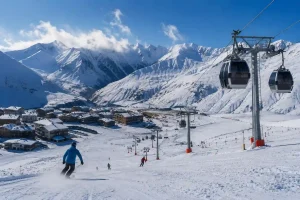
2. Take the Kukushka Train to Bakuriani
With softer slopes, kid-friendly winter parks, and a slower, more conventional pace than Gudauri, Bakuriani is Georgia’s family-friendly ski resort. A picturesque way to get there is via the historic narrow-gauge train from Borjomi known as the Kukushka, or cuckoo.
3. Chase Snow in Kazbegi, Stepantsminda
For one of the most photographed winter views in the Caucasus, drive or hike up to the Gergeti Trinity Church, which is situated on a mountaintop beneath the more than 5,000-meter-high Mount Kazbek. The nearby Gveleti Waterfall is a frozen cascade that may be reached by hiking through Dariali Gorge.
4. Warm Up in Tbilisi’s Sulfur Baths
The historic bathhouse neighborhood of Abanotubani in Tbilisi is the ideal remedy for a chilly day. The most well-known, domed brick bathhouses, the Orbeliani Baths, are a very calming, authentically Georgian way to spend a winter afternoon. They employ naturally heated mineral water that is high in sulfur.
5. Go Off the Beaten Path in Svaneti
While distant Tusheti and Khevsureti close completely during the winter, Svaneti, which is home to the UNESCO-listed medieval tower village of Ushguli, remains open. This is one of the most beautiful winter scenes in the area, with snow-capped stone koshki towering against the Caucasus skyline. Some of the longest ski seasons in the nation may be found at the resorts of Hatsvali and Tetnuldi, which are close to Mestia.
6. Taste Wine by the Fireplace in Kakheti
The wine region of Georgia continues throughout the winter. Indoor tastings of traditional qvevri-aged wine, often accompanied with a robust winter supra, are offered by numerous family-run wineries in the Sighnaghi and Telavi regions.
7. Eat To Get Through Winter
When Does It Snow in Georgia, Georgian comfort cuisine is at its best in its prime time: warm chikhirtma chicken soup, khinkali dumplings, steaming khachapuri cheese-filled bread, and glasses of mulled wine or chacha to end. From December to February, nearly every restaurant in Tbilisi follows this seasonal menu.
8. Celebrate the Georgian Holiday Season
Georgia essentially has a month-long holiday season, with the Western New Year falling on December 31, Orthodox Christmas on January 7, and Old New Year on January 14. Long into mid-January, expect festive lights throughout Tbilisi’s Old Town, special family dinners, and a vibrant, joyous atmosphere.
9. Try Snowshoeing or Winter Hiking
Without requiring any technical expertise, guided winter treks and snowshoeing excursions in Svaneti, Kazbegi, or Borjomi-Kharagauli National Park allow you to discover Georgia’s valleys and forests at a slower pace than skiing.
Places to Visit in Georgia
- The capital and ideal starting point for any journey is Tbilisi. Discover Abanotubani’s sulfur baths, the Old Town, Narikala Fortress, and a bustling winter wine bar and restaurant scene.
- The Jvari Monastery and Svetitskhoveli Cathedral may be found in Mtskheta, Georgia’s historic former capital and a UNESCO World Heritage Site. It’s a short day trip from Tbilisi.
- Kazbegi (Stepantsminda): The Gergeti Trinity Church and Mount Kazbek are the main features of the dramatic conclusion of the Georgian Military Highway.
- The best ski resort in Georgia, Gudauri, is just two hours from Tbilisi and features major off-piste terrain and slopes for all skill levels.
- Bakuriani is a more sedate, family-friendly ski town that can be reached from Borjomi via the picturesque Kukushka train.
- The isolated, mountainous Svaneti Mestia and Ushguli region is well-known for its medieval stone towers and some of the longest ski seasons in the nation.
- The wine region of Kakheti, Georgia, is concentrated on the cities of Telavi and Sighnaghi.
- Borjomi is well-known for its spring water and the Borjomi-Kharagauli National Park, which is ideal for more leisurely walks in the winter.
- Georgia’s Black Sea vacation city is called Batumi. A true snow day on the coast is uncommon, albeit it has occurred during very powerful storms. Winters here are moderate, rainy, and humid rather than snowy.
When Does It Snow in Tbilisi?
The brief response is as follows: In Tbilisi, snow can fall at any time between December and March, although it rarely does. The capital typically receives only one to three days of snowfall annually, and it’s incredibly erratic; some winters go by with hardly any snowfall, while an infrequent large snowfall will cover the Old Town for a day or two before melting away. A few reasons for this:
- By regional standards, the winters in Tbilisi are moderate. From December thru February, daytime highs usually range from 2°C to 8°C, with nightly lows of 0°C to -2°C. Even when snow does fall for a short while, it is frequently too warm for it to remain.
- When does it snow in Georgia, it usually lasts only a few hours. Instead of fresh snow, locals usually wake up to a little dusting that has already melted by midmorning and is typically followed by rain.
- Your greatest chance is in late winter. In Tbilisi, snowy days are more common in late January, February, and sometimes even early March than in December.
- The odds are better in nearby hills. The Kojori forest, which is located just outside of Tbilisi, frequently has snow during the coldest weeks, even while the city center remains barren, if you wish to witness snow close to the capital.
Plan a day trip or overnight stay in Gudauri, Kazbegi, or Bakuriani, where snowfall is almost guaranteed starting in December, if you want to see actual snow during your vacation. Don’t base your schedule just on Tbilisi.
Conclusion
Georgia’s snow story is really two stories combined. Winter in the highlands of Kazbegi, Gudauri, Bakuriani, and Svaneti is exactly what you’d expect: consistent snowfall from December through March, great skiing, and picturesque views of snow-covered Orthodox churches and stone towers. Tbilisi is a gentler experience: mild days, the occasional snowy morning, sulfur baths, and festive markets.
The rule for planning your trip is simple: head to the highlands between December and February if you want real snow, or choose Tbilisi for a comfortable winter city break with snow as a bonus. Whether you pick the snowy peaks of Kazbegi or the charm of Tbilisi, Makani Travel and Tourism, the best travel agency in the UAE, can plan your entire winter trip from flights to ski resorts.
FAQ
Does Georgia experience snowfall?
Indeed. The alpine regions of Kazbegi, Gudauri, Bakuriani, and Svaneti frequently see snowfall from November to March, with the biggest snowfall occurring between December and February. Snowfall is far less common in Batumi and Tbilisi.
In Georgia, which month does it typically snow?
Snowfall in the mountains usually starts in November, peaks in December and February, and occasionally continues into March or April at high elevations. Snowfall occurs mostly in late January and early February in Tbilisi.
Does Tbilisi experience snowfall?
Rarely, but occasionally. Snow melts rapidly, and Tbilisi experiences one to three snowy days annually, typically in late January or early February.
Does winter in Georgia get chilly?
Depending on the area, yes. While alpine regions might see nighttime lows of -10°C to -20°C, Tbilisi typically has daily temperatures between 2°C and 8°C. Batumi is rainy and mild.
Which month is ideal for snowfall in Georgia?
The deepest and most consistent mountain snow is typically found in February. In Gudauri, Bakuriani, and Svaneti, January and February are the best months to go skiing.
