



Azerbaijan is a small country, but a single trip through it brings together a capital where a 12th-century tower stands beside illuminated skyscrapers, a historic Silk Road town with high-pitched sloping rooftops, a mountain city with modern ski resorts, and another with a semi-tropical climate and ancient forests stretching along the Caspian coast. With this kind of variety, you can explore the best cities in Azerbaijan within a geographic range that fits a one-week itinerary. This guide takes you through the most notable cities, clarifying what makes each destination distinct and who it suits best.
What Are the Best Cities to Visit in Azerbaijan
This table gives you a quick overview of the main cities and what each one offers:
| City | Best For | Ideal Stay | Distance from Baku |
|---|---|---|---|
| Baku | All travelers | 3 to 4 days | Capital |
| Gabala | Nature, families, skiing | 1 to 2 days | 220 km |
| Sheki | History, culture, Silk Road | 1 to 2 days | 350 km |
| Ganja | Local culture and history | 1 day | 375 km |
| Quba | Mountain scenery and heritage | 1 to 2 days | 168 km |
| Lankaran | Nature, relaxation, coastline | 1 to 2 days | 260 km |
| Shamakhi | Short historical escape | Half day to 1 day | 122 km |
Baku: Best City in Azerbaijan for First-Time Visitors

On the shore of the Caspian Sea sits Baku, the capital of Azerbaijan, with a population exceeding one and a half million people. During the oil boom of the early twentieth century, the city’s new wealth reflected itself in Baroque mansions and classical facades lining Nizami Street and the seafront boulevard. At the same time, the three Flame Towers stand beside the UNESCO-listed Old City, forming a striking architectural contrast between the past and the present.
Why Visit Baku
Baku is the primary departure point for most trips to Azerbaijan, and it is usually the return point as well. More than sixty international destinations connect directly through its international airport, and most of the main attractions sit within areas that can be explored on foot or reached by taxi within a short distance. Three days give you enough time to discover the city’s highlights without needing complex planning.
Best Things to Do in Baku
Among the most worthwhile experiences in Baku:
- Icherisheher, the UNESCO-listed Old City, with its narrow lanes, mosques, and historic caravanserais
- The Maiden Tower, one of the city’s oldest landmarks, offering panoramic views of the sea and the city from its top
- The Palace of the Shirvanshahs, a 15th-century building at the highest point of the Old City
- The three Flame Towers, which transform into dynamic light shows after sunset
- The Heydar Aliyev Center, designed by Zaha Hadid with its iconic curved lines
- Baku Boulevard, stretching five kilometers along the Caspian waterfront
Top Attractions in Baku
Sixty-four kilometers from Baku lies Gobustan, where rock carvings dating back twenty thousand years stand alongside unique mud volcanoes. Yanar Dag, known as the burning mountain for its natural flames, sits about 25 kilometers away.
At Ateshgah, a fire-worship site tied to Zoroastrianism and Hinduism, the layered history of the civilizations that once passed through this land becomes visible.
How Many Days Do You Need in Baku
Three days give you time to visit the Old City, the Flame Towers, the boulevard, and the Heydar Aliyev Center, with one day set aside for a trip to Gobustan. The fourth day can be used for Yanar Dag, Ateshgah, and the city’s museums. Those who prefer a slower pace, moving between restaurants and cafes and getting a feel for local life, may need a full week.
Who Should Visit Baku
Baku’s variety makes it a good fit for different types of travelers. The city’s historical layers, from the medieval period through the oil era, draw history enthusiasts, while its sharp contrast between historic buildings and contemporary design appeals to architecture lovers.
Families have the boulevard, amusement parks, and gardens, and business travelers find international hotels alongside professional infrastructure.
Gabala: Best Cities in Azerbaijan for Mountains and Nature
In northern Azerbaijan, on the slopes of the Greater Caucasus Mountains, lies Gabala at an elevation of 700 meters. About 2,600 years ago it served as the capital of ancient Caucasian Albania, and today it combines historical sites with forests, lakes, mountains, and a modern ski resort that operates year-round.
Why Visit Gabala
Gabala offers a different experience from the capital: clean mountain air, dense forests, a calm lake, a winter ski resort, and a cable car that delivers wide-open views throughout the summer. The drive from Baku covers 220 kilometers, or roughly three and a half hours, so it works either as a day trip or as a two-day stay.
Best Things to Do in Gabala
The most notable experiences in Gabala include:
- Tufandag Mountain Resort, with its cable car spanning 12 kilometers above the forests
- Nohur Lake at 700 meters elevation, where the Caucasus peaks reflect on calm waters
- The seven-tiered Yeddi Gozel Waterfalls in the forests of Vandam Valley
- The Gabala Archaeological Center, with finds from the ancient city
- Gabalaland, an amusement park that includes an ice skating rink
Tufandag Mountain Resort
Tufandag ranks among the main ski resorts in the Caucasus region. Its prepared runs stretch 15 kilometers and are graded green, blue, red, and black to suit different skill levels. Four cable car lines with a combined length of over 12 kilometers rise from 900 meters to nearly 1,920 meters.
In winter the resort operates as a ski destination, and in summer it receives visitors for hiking and cable car rides.
Nohur Lake
At 700 meters above sea level, Nohur Lake sits in Gabala surrounded by the Yomru, Goydagh, and Golubrun mountains. Its calm turquoise waters reflect the surrounding forests, which shift in color between winter and summer. The Nohur Restaurant overlooking the shore offers one of the more scenic spots to sit in the area.
Yeddi Gozel Waterfall
Yeddi Gozel means “seven beauties,” and these waterfalls descend across seven levels through the forests of Vandam Valley. The three lower levels are accessible via stone steps, while the four upper levels require a more demanding hike. Entry is free, and the trip by taxi from Gabala takes around 30 to 40 minutes.
Is Gabala Good for Families
Gabala brings together several activities suited to family trips. Tufandag’s green runs are designed for beginners, and a ski school for children operates on site. Gabalaland provides playgrounds and an ice rink, while Nohur Lake offers space for easy family walks, and an archery range rounds out the city’s activity options.
Is Gabala Worth Visiting in Winter
Winter gives Gabala an entirely different character. The ski season at Tufandag opens on December 15, and snow covers the area and transforms its landscape. The Qafqaz Tufandag Mountain Resort hotel, with its full spa and five restaurants, is one of the winter accommodation options in the area.
Don’t miss: Gabala in December
Sheki: Best City for History and Culture
Sheki sits at the foot of the Greater Caucasus Mountains at an elevation of 600 meters, and it is one of Azerbaijan’s oldest and culturally richest cities. It once served as a significant stop on the Silk Road, and the traces of that history remain visible in its traditional crafts and distinctive architecture. The city was inscribed on the UNESCO World Heritage List in 2019.
Why Visit Sheki
Away from Baku’s pace, Sheki gives visitors the chance to discover a different side of Azerbaijan. The cobbled streets, houses with high-pitched sloping rooftops, confectionery shops, tea houses, and craft workshops all form part of the city’s everyday scene. From Baku, the distance is about 350 kilometers, and the bus journey takes four to five hours.
Sheki Khan’s Palace
Sheki Khan’s Palace was built in 1797, and its core structure stands as a notable architectural example constructed without a single nail. The shebeke stained-glass windows contain more than 5,000 pieces of colored glass fitted together without adhesive in precise geometric patterns.
The original wall paintings still display hunting scenes, flowers, and birds in their colors after two centuries. Entry is charged at a modest fee, and the palace holds a prominent place among the Sheki landmarks that visitors consistently recommend.
Sheki Historic Centre
The entire historic center of Sheki is UNESCO-listed, and within it run cobbled streets and buildings with double-pitched sloping roofs that reflect the local architectural style, which shows the combined influence of Safavid, Qajar, and Russian traditions. Sheki Bazaar contains shops for handicrafts, copperware, textiles, and local sweets, making it part of the cultural experience rather than simply a place to shop.
Sheki Caravanserai
The Sheki Caravanserai dates to the 18th century and historically received Silk Road merchants arriving from China, India, and Persia. What makes it particularly notable is that the building still functions as a hotel today. One night in its rooms with thick stone walls and vaulted ceilings gives the stay a distinctly historical quality.
What Food Is Sheki Famous For
Sheki is known for its local cuisine, and at the top of its dishes is piti, a slow-cooked meat and chickpea soup prepared in clay pots. Sheki halva is a type of baklava made from layers of nuts and thin pastry, while dam dam comes as a richer version of halva combining hazelnuts, walnuts, and almonds. Sheki is one of five Azerbaijani regions selected as part of the global Slow Food alliance.
How Long Should You Stay in Sheki
One day is enough to visit the Khan’s Palace, the historic center, the caravanserai, and the bazaar. A second day allows for a trip to the nearby Albanian Kish Church, the village of Ilisu, and its waterfall. Choosing the caravanserai for accommodation makes an overnight stay in the city part of the experience itself.
Read more: Azerbaijan things to see
Ganja: Best City for Local Culture and History
Ganja, the second-largest city in Azerbaijan, sits in the west of the country and is the birthplace of the Persian poet Nizami Ganjavi, one of the most prominent poets of the Islamic world in the 12th century. The city retains a clearly local character away from heavy tourism, alongside a collection of historical and architectural landmarks.
Why Visit Ganja
Ganja gives visitors the chance to experience Azerbaijan through daily local life, away from the concentrated tourist atmosphere. Despite being the country’s second-largest city, it still holds on to its local character. The distance from Baku is about 375 kilometers, and it can be reached by train or bus.
Best Things to Do in Ganja
These landmarks are worth including in a Ganja itinerary:
- The Nizami Mausoleum, located just outside the city, with an adjacent museum displaying rare original manuscripts
- Juma Mosque with its Safavid architecture dating to the 17th century
- Javad Khan Street with its outdoor cafes, local activity, and student atmosphere
- A trip to Goygol National Park, located about one hour from the city
Nizami Mausoleum
The Nizami Mausoleum sits just outside the city, and the architectural complex was originally built in 1947 and then reconstructed in its current form in 1991. In front of the mausoleum stretches a plaza decorated with symbolic sculptures drawn from the poet’s five major works. The adjacent museum displays original manuscripts and rare editions of his writings held in libraries from Vienna to London.
Juma Mosque
The site of Juma Mosque in Ganja traces back to the 8th century AD, while the current structure was built in the 17th century. Its Safavid style is evident in the design, and decorated blue tiles stand out on the facades, which are details that recall the mosque architecture of Shiraz and Isfahan.
Bottle House
Among Ganja’s more unusual architectural landmarks is the Bottle House, which Ibrahim Jafarov built in 1967 as a memorial to his brother who died during World War II. The exterior is covered with more than 50,000 glass bottles of varying sizes and colors, making the structure look like a work unlike anything else in the city’s traditional streetscape.
How Long Should You Stay in Ganja
One day is enough to explore the main landmarks in Ganja. A second day allows for a visit to Goygol Lake and Goygol National Forest, located about one hour away. The city also works as an overnight stop within a route heading through western Azerbaijan before returning to Baku.
Quba: Best City for Mountain Scenery and Culture
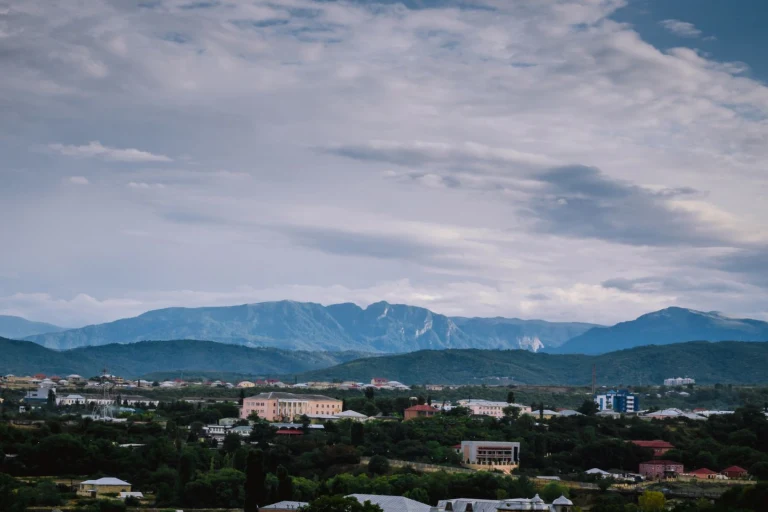
Quba sits in northeastern Azerbaijan at an elevation of 650 meters on the slopes of Mount Shahdag. It lies 168 kilometers from Baku and is known for producing some of the finest apples in Azerbaijan, as well as for a cooler summer climate compared to the coastal cities. It also serves as a gateway to the northern Azerbaijani Caucasus region.
Why Visit Quba
Between dense forests, isolated mountain villages, and diverse cultural heritage, Quba offers a mix of nature and local life. From there, visitors can reach mountain villages like Khinalig, Kandi Ob, and the Red Village, while the less crowded atmosphere adds a different quality to the visit.
Best Things to Do in Quba
The most worthwhile experiences to include in a Quba itinerary:
- The cascading Afurja Waterfalls within the forests of Qiraq Kasaman
- Khinalig village, one of Azerbaijan’s oldest and highest settlements at 2,300 meters elevation, distinguished by its unique local language
- Qiraq Kasaman Forest with its shaded trails and woodland atmosphere
- The Qiraq Kasaman Archaeological and Ethnographic Museum
Quba Old Town
The buildings and traditional mosques of the old quarter reflect the city’s cultural identity. Juma Mosque with its red stone facade and quiet courtyard stands among the most prominent landmarks there. During the apple harvest season in autumn, Quba is also associated with its annual festival.
Red Village
The Red Village, also known as Krasnaya Sloboda, is one of the most notable cultural destinations in Quba. It is described as the largest settlement of Mountain Jews in the world outside Israel, and it is home to members of this community whose history in the Caucasus spans centuries.
The village’s streets, synagogues, and buildings, which blend Azerbaijani and Jewish architectural elements, offer a distinct cultural experience.
Quba Genocide Memorial Complex
The Quba Genocide Memorial Complex commemorates the victims of the events of 1918, during which thousands of Azerbaijanis were killed according to the historical account tied to this site.
The museum presents historical materials documenting those events and their context, giving the visit a historical and cultural dimension that differs from the area’s other attractions.
Day Trips from Quba
Quba allows for several day trips to the surrounding areas. Khinalig, the isolated mountain village, sits about two hours away by four-wheel drive. The Kandi Kain Mountains, with their red and white geological formations, are located about one hour out, while the Laza Waterfalls are spread across the mountain areas surrounding Qusar.
Lankaran: Best City for Nature and Relaxation
In the far south of Azerbaijan, on the Caspian coast near the Iranian border, sits Lankaran. Its position between the sea and the western Talysh Mountains gives it a distinctive semi-tropical climate, and it is among the country’s greenest and most rain-rich cities, closely tied to producing a significant portion of Azerbaijan’s tea.
Why Visit Lankaran
The scenery here differs from Baku, Sheki, and Quba. The UNESCO-listed ancient Hyrcanian forests, tea culture, the cuisine of the Talysh region, and the quiet Caspian beaches all come together in one destination. The distance from Baku is about 260 kilometers.
Lankaran Beaches and Caspian Coast
Lankaran’s beaches are quieter than those of Baku and its resort areas. During summer, the Caspian waters in the south are warmer than in the northern stretches. The local coastline runs between the forests and open water, presenting a scene distinct from the rest of the region’s shores.
Hirkan National Park
Hirkan National Park holds UNESCO World Natural Heritage status and contains ancient Hyrcanian forests dating back millions of years. Iron trees with lifespans exceeding 400 years grow within it, alongside the rare Caucasian leopard and more than 150 bird species. Guided trails through the park are among the main nature activities available in Lankaran.
Tea Plantations
Lankaran has been cultivating Azerbaijani tea across its hills for nearly 100 years, and tea culture has become woven into local life and heritage. Visiting a traditional home and drinking tea there gives travelers a chance to connect with this aspect of the local culture.
Lankaran’s Local Cuisine
The cuisine of the Talysh region differs from other parts of Azerbaijani cooking. Kutum fish from the Caspian is one of the local specialty dishes, and local vegetables and distinct spices add their own flavors to the food. Traditional cafes serve local tea in small glasses alongside varieties of homemade jam.
Is Lankaran Worth Visiting
Lankaran suits travelers looking for a different side of Azerbaijan away from the standard tourist routes. The semi-tropical forests, local tea, the region’s distinct cuisine, and the quieter atmosphere all make it unlike Baku or Sheki, and it is especially worth considering for a traveler who wants to add a genuinely different destination to their itinerary.
Shamakhi: Best City for a Short Historical Escape
Shamakhi sits at the foot of the Caucasus Mountains, 122 kilometers from Baku. The city was once the capital of the Shirvan Empire and an important commercial hub on the Caucasian Silk Road, and it holds today a historic mosque, a well-known astronomical observatory, and agricultural areas recognized for their vineyards.
Why Visit Shamakhi
Its short distance from Baku makes Shamakhi a natural fit for a day trip or a stop along the road to Sheki. The city’s name is connected to poets like Nizami and Khaqani, which adds a literary dimension to its history.
For those who want to combine history and nature without covering long distances, it fits easily into any Azerbaijan itinerary.
Juma Mosque
The origin of Juma Mosque in Shamakhi traces back to the 8th century AD, and the current structure has passed through several phases of restoration over the centuries. The mosque remains in active use, and its traditional Islamic character alongside its quiet interior courtyard are both evident to visitors.
Shamakhi Observatory
The Shamakhi Astrophysical Observatory is one of the recognized landmarks in the area and one of the significant observatories in the Caucasus. It stands on a hill rising 26 meters above the city and offers wide views toward the Caucasus Mountains. At certain times it is open to visitors for stargazing.
Vineyards and Wine Tourism
Shamakhi is known for its vineyards and the local grape varieties grown there. On the road from Baku to the city, vineyards stretch across wide areas, and autumn colors appear clearly between September and November. Some farms receive visitors, which makes the autumn season a particularly fitting time to explore this area.
Best Day Trips from Shamakhi
From Shamakhi, visitors can reach the Yeddi Gumbaz seven-domed mausoleums, which are tombs connected to the Shirvan khans. The craft village of Lahij sits about one hour away and is known for traditional copperwork that has preserved its historical character.
Diri Baba is a shrine carved into a rocky cliff, and from the outside it appears as a cylindrical structure projecting directly from the rock face.
Best Azerbaijan Cities by Travel Style
| If You Want | Best City |
|---|---|
| History and culture | Sheki, Baku, Shamakhi |
| Mountain nature | Gabala, Quba |
| Beach and relaxation | Lankaran |
| Urban life and architecture | Baku |
| Authentic local culture | Ganja, Sheki |
| Skiing and winter activities | Gabala Tufandag |
| Short trip from Baku | Shamakhi, Gobustan |
| Adventure and mountain villages | Quba, Khinalig |
Which City in Azerbaijan Is Best for Families
Gabala brings together several activities that families can fit into one itinerary. Tufandag provides beginner runs, a ski school, and a winter activity zone for children, while Gabalaland offers playgrounds and an ice rink.
Nohur Lake is suited for easy family walks, and Baku remains a solid urban option with its boulevard, parks, and museums. In autumn, Quba can also suit families looking for mountain nature in a quieter local setting.
Which City in Azerbaijan Is Best for Couples
Sheki offers a quiet historical atmosphere through its caravanserai, iconic palace, and stone-paved lanes. In Baku, couples can combine fine dining, panoramic views, and the nighttime spectacle of the Flame Towers.
Gabala brings together nature, the Tufandag spa, and cable car rides above the forests, while Shamakhi provides a shorter option set among vineyards and historical landmarks.
Best Cities in Azerbaijan for UAE Travelers
Baku sits about three flight hours from Dubai via Heydar Aliyev International Airport, and regular flights between the two countries are operated by airlines including flydubai and Azerbaijan Airlines. UAE residents also benefit from entry and visa facilitation under the applicable regulations.
A five-day itinerary from the UAE can be divided as follows: three days in Baku and its surrounding attractions, one day for Gabala and Tufandag as a round trip, and one day for Shamakhi and Qiraq Kasaman.
A seven-day itinerary can be spread across two days in Baku, one day in Shamakhi, one to two days in Sheki, one day in Gabala, and an extra day for either Ganja or Quba.
Read more: Azerbaijan snow season
Best Time to Visit Azerbaijan’s Cities
| Season | Best Cities |
|---|---|
| Spring, March to May | Baku, Shamakhi, Sheki, with nature at its best |
| Summer, June to August | Quba and Gabala to escape the heat, and Lankaran’s beaches |
| Autumn, September to November | Shamakhi, Sheki, and Ganja with vineyard colors and harvest season |
| Winter, December to February | Gabala Tufandag for skiing and Baku at lower prices |
Best Cities in Azerbaijan Quick Comparison
| City | Best For | Ideal Stay |
|---|---|---|
| Baku | All travelers | 3 to 4 days |
| Sheki | History and the Silk Road | 1 to 2 days |
| Gabala | Nature, families, and skiing | 1 to 2 days |
| Quba | Mountains, villages, and adventure | 1 to 2 days |
| Ganja | Local culture and history | 1 day |
| Lankaran | Semi-tropical nature and relaxation | 1 to 2 days |
| Shamakhi | Short historical escape | Half day to 1 day |
Why Choose Makani Travel and Tourism to Explore Azerbaijan’s Cities
Makani Travel and Tourism in Ajman brings 22 years of experience in the tourism industry, and that shows in how a trip is organized and in the details that are handled before the traveler even arrives at the destination. The company’s presence in Azerbaijan gives it direct knowledge of hotels, routes, and seasons, and its tailored Azerbaijan packages cover accommodation, intercity transfers, and tours according to the specified budget.
Makani has been ranked among the top 100 travel companies in the world and received the Best Travel Agency in Ajman award for 2025. Those interested in organizing a trip to Azerbaijan can reach the team or visit the company’s office in Ajman.
Conclusion
The best cities in Azerbaijan stretch from a modern capital to a Silk Road town, from mountain cities to a semi-tropical coastline, and all of that sits within a geographic range that can be explored in a single trip. Three days give you a solid start in Baku, while a full week opens up the chance to move between a wider set of cities and attractions.
FAQ
What Are the Top 5 Cities in Azerbaijan
Among the top five cities are Baku, Sheki, Ganja, Gabala, and Quba, offering a mix of history, culture, nature, skiing, and access to Azerbaijan’s northern mountain regions.
Which Is Better, Baku or Turkey
It depends on your preferred experience. Turkey offers greater geographic and historical variety, while Baku and Azerbaijan provide a different mix of sites, culture, and experiences.
Is Baku a Cheap City
Baku is generally mid-range in cost, cheaper than Dubai and some Western European cities but often more expensive than Georgia and Armenia.
Is 7 Days Enough for Azerbaijan
Yes. Seven days can cover Baku, Sheki, Gabala, and another destination such as Shamakhi or Quba. Visiting southern Azerbaijan generally requires around ten days.
What to Avoid in Baku
Watch for higher restaurant prices along the main boulevard and use caution with unofficial taxis. Checking fares beforehand and using Bolt can make transportation easier.
Which Month Is Better to Visit Azerbaijan
April, May, September, and October offer mild weather for general tourism. December to March suits skiing, while summer is suitable for cooler mountain destinations like Quba and Gabala.
